Advanced Guide for PCP Airgunners: The Science of Lightweight High-Pressure Cylinders & Hydrostatic Testing
2026.03.04
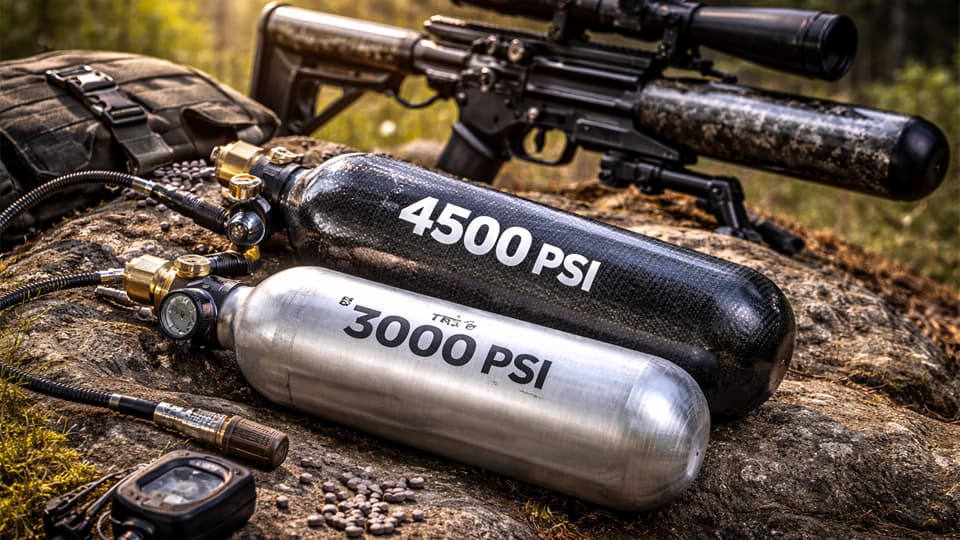
For competitive shooters and outdoor hunting enthusiasts dedicated to PCP (Pre-Charged Pneumatic) airguns, pinpoint accuracy is essential. However, the true engine behind every perfect shot is the steady, reliable air supply provided by a high-pressure cylinder.
When operating pressures routinely reach 3000 PSI or even 4500 PSI, the "safety" and "lightweight portability" of the cylinder become the two most critical concerns for any serious airgunner. With over 30 years of professional manufacturing expertise, Bobson Cylinders dives deep into the material science of high-end PCP cylinders and the life-saving importance of the Hydrostatic Test (Hydro Test).
Why Do PCPs Need Specialized High-End Cylinders?
Unlike standard paintball markers (which typically operate at 800-3000 PSI) or aquarium CO2 tanks, modern PCP systems require compressed air forced to extreme pressures of up to 4500 PSI (approx. 300 Bar). This extreme pressure is necessary to achieve higher muzzle velocities, flatter trajectories, and a greater number of shots per fill.
Under such immense pressure, traditional industrial steel cylinders are not only impractically heavy for field use, but their pressure limits and risk of metal fatigue fail to meet the rigorous demands of modern PCP shooters. Upgrading the cylinder material is not just an option; it's a necessity.
The Perfect Balance of Lightweight & High Strength: 6061-T6 Aluminum & Composites
To eliminate the burden of "carrying a heavy bomb" through the woods or across the range, modern premium PCP cylinders have undergone a revolution in material design:
- Seamless Aerospace-Grade Aluminum (6061-T6): Bobson Cylinders extensively uses premium 6061-T6 aluminum alloys for our cylinder liners. This material boasts exceptional yield strength while weighing only about half as much as a traditional steel tank. Most importantly, it will never rust internally, ensuring that the air pumped into your expensive rifle barrel remains 100% pure and free of debris that could destroy precision valves.
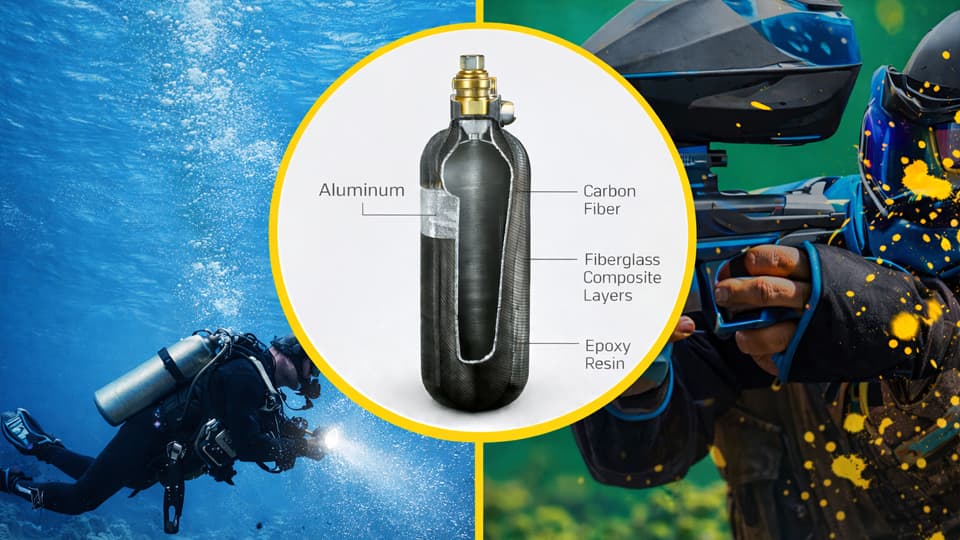
- Carbon Fiber Wrapped Technology: To further reduce weight at the extreme limit of 4500 PSI, top-tier cylinders feature an aluminum core meticulously wrapped in high-strength carbon fiber and fiberglass, cured with epoxy resin. This dramatically multiplies the structural integrity while pushing lightweight design to its absolute limit—making it the ultimate choice for competitive shooters.
What is a Hydrostatic Test? Why is it a Matter of Life and Death?
No matter how pristine your cylinder looks on the outside, metal and composite materials can develop microscopic cracks or "metal fatigue" after years of high-to-low pressure cycling. This is exactly why the Hydrostatic Test is strictly enforced.
How a Hydrostatic Test Works:
- Water Filling: The cylinder is completely filled with water. (Water is an incompressible fluid; if the tank ruptures during testing, it will simply leak rather than create a deadly, explosive shockwave like compressed gas would).
- Pressurization: The water-filled cylinder is placed inside a sealed, water-filled test jacket. It is then pressurized well beyond its normal working pressure (typically 5/3 of the working pressure—for example, a 4500 PSI tank is tested at 7500 PSI).
- Measuring Expansion: Under this extreme pressure, the cylinder will expand slightly, displacing water from the test jacket. Engineers precisely measure this displaced water to calculate the Total Expansion and, once depressurized, the Permanent Expansion.
- Pass/Fail Criteria: If the permanent expansion exceeds regulatory limits (usually more than 10% of the total expansion), it indicates the material has lost its elasticity. The cylinder will fail the test, be legally condemned, and must be destroyed.
How to Read Cylinder Stampings: Is Your Tank Expired?
For your own safety, every PCP player must know how to read the stampings engraved on the crown of their cylinder. These numbers and letters serve as the tank's ID and medical record:
- Specification & Material: Look for marks like DOT-3AL or ISO 7866, indicating compliance with the US Department of Transportation or international standards for aluminum cylinders.
- Working Pressure: Marks like 3000 PSI or 4500 indicate the maximum safe fill pressure. Never overfill your tank.
- Manufacture/Test Date: A stamp like 05 25 means the tank was manufactured or successfully hydro-tested in May 2025.
- Retest Cycle: Depending on local regulations and the material (pure aluminum vs. carbon fiber wrapped), cylinders typically require a new hydro test every 3 to 5 years. Carbon fiber tanks often have a strict 15-year maximum lifespan, after which they must be retired regardless of condition.
Bobson Cylinders: Engineering with Zero Compromise
In the world of 4500 PSI, there is no room for "good enough"—only zero-tolerance safety standards.
Every high-pressure cylinder produced by Bobson Cylinders—from aluminum billet extrusion and heat treatment to thread machining and final factory hydrostatic testing—strictly complies with ISO 9001 and ISO 13485 (Medical Grade) certification standards. We are not just a global leader in OEM/ODM high-pressure cylinder manufacturing; we are the most reliable backup for shooters on the competitive field.