
A Global Leader in
High-Pressure Cylinders
and Green Energy
High-Pressure Cylinders
and Green Energy
Aluminum cylinders maintain distinct advantages over composite cylinders in gas storage applications through superior cost-effectiveness, proven recyclability, established DOT3AL certification pathways, and decades of safety validation. While composite cylinders offer weight benefits, aluminum solutions deliver better total lifecycle value for B2B enterprises requiring high pressure gas storage across medical, industrial, and specialty applications.
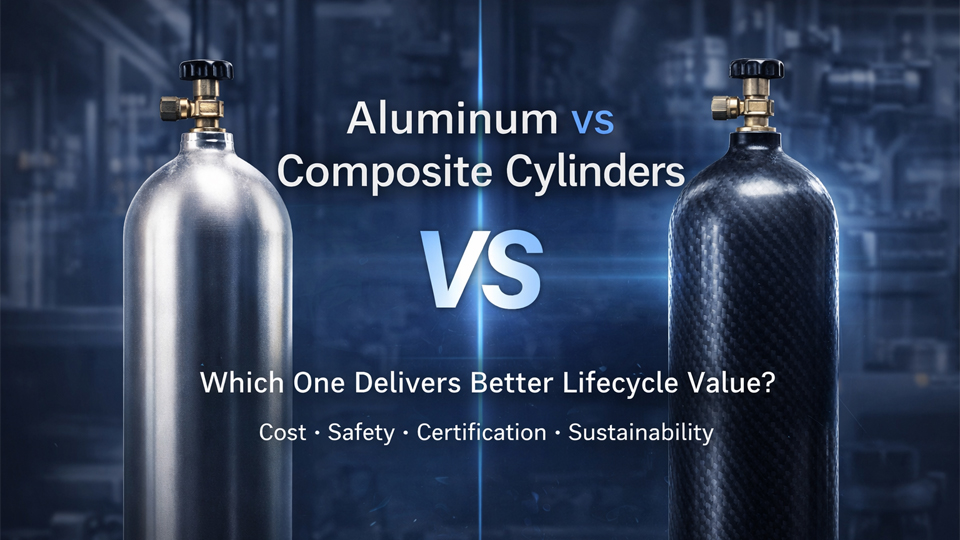
Aluminum cylinders provide significantly lower initial purchase costs compared to composite alternatives, making them accessible for enterprises scaling their gas storage infrastructure. The manufacturing process for aluminum high pressure cylinders has been refined over decades, creating economies of scale that composite technology has yet to achieve. For B2B buyers procuring cylinders in volume—whether medical oxygen cylinders for healthcare networks or industrial gas cylinders for manufacturing facilities—the 40-60% cost differential between aluminum and composite options directly impacts capital expenditure budgets.
Maintenance and lifecycle costs further favor aluminum cylinders, as they require straightforward inspection protocols and widely available service expertise. Unlike composite cylinders that may require specialized ultrasonic testing or thermal imaging inspection, aluminum cylinders can be visually inspected and hydrostatically tested using standard industry equipment. This accessibility reduces long-term operational expenses and simplifies compliance with DOT3AL recertification requirements. Manufacturing facilities and gas distributors benefit from established service networks capable of maintaining aluminum cylinder fleets without specialized composite expertise.
Aluminum offers complete recyclability at end-of-life, creating circular economy value that composite materials cannot match. When aluminum cylinders reach retirement after 20-30 years of service, the aluminum can be recycled indefinitely without quality degradation, recovering approximately 95% of the energy required to produce primary aluminum. This sustainability advantage resonates with enterprises implementing ESG initiatives and corporate environmental commitments. Composite cylinders, by contrast, face recycling challenges due to their multi-material construction combining carbon fiber, resin matrices, and metal liners—often resulting in landfill disposal or energy-intensive breakdown processes.
The established aluminum recycling infrastructure provides practical end-of-life solutions that composite alternatives lack. B2B enterprises can partner with metal recyclers to reclaim value from retired cylinder inventories, offsetting replacement costs while meeting sustainability reporting requirements. This closed-loop capability positions aluminum cylinders as the environmentally responsible choice for organizations balancing performance requirements with environmental stewardship. Custom cylinder manufacturers like Bobson Cylinders can support sustainability programs by facilitating cylinder retirement and recycling coordination.
DOT3AL certification for aluminum cylinders represents a mature, well-understood regulatory framework that simplifies compliance for gas storage applications. The DOT3AL specification has governed aluminum high pressure cylinder manufacturing since 1988, creating standardized testing protocols, manufacturing requirements, and quality assurance expectations recognized across industries. This regulatory clarity accelerates procurement processes, as purchasing managers can specify DOT3AL certification with confidence in consistent performance standards. Composite cylinder certifications vary by manufacturer and construction method, requiring more detailed specification review and validation.
The extensive performance history of DOT3AL certified aluminum cylinders provides risk mitigation that emerging composite technologies cannot yet demonstrate. Decades of field data across medical oxygen cylinders, soda cylinders, and industrial gas cylinders validate aluminum's reliability under diverse operating conditions. For risk-averse sectors like healthcare and aerospace, this proven track record reduces adoption barriers and supports regulatory approval processes. When enterprises evaluate gas storage solutions for critical applications, the documented safety history of aluminum cylinders carries significant weight in decision matrices.
Aluminum cylinders excel in applications requiring corrosion resistance, particularly for medical oxygen and specialty gas storage. The natural oxide layer on aluminum surfaces provides inherent protection against moisture and atmospheric corrosion without additional coatings. Medical facilities storing oxygen cylinders in varied environmental conditions—from climate-controlled hospital wings to ambulance compartments—benefit from aluminum's durability. Industrial gas cylinders containing corrosive specialty gases or operating in marine environments similarly leverage aluminum's material properties. While composite cylinders resist corrosion, their polymer matrices can degrade under UV exposure or chemical contact depending on resin selection.
Temperature performance characteristics favor aluminum in applications involving thermal cycling or extreme temperature exposure. Aluminum cylinders maintain structural integrity across temperature ranges from cryogenic to elevated conditions, making them suitable for industrial processes with thermal variation. The material's thermal conductivity facilitates faster filling processes by dissipating compression heat, improving operational efficiency for gas distribution operations. Composite materials exhibit temperature sensitivity requir ing careful monitoring to prevent matrix degradation—a consideration for cylinders exposed to direct sunlight, industrial heat sources, or refrigerated storage.
Custom manufacturing capabilities for aluminum cylinders enable precise specification matching for unique B2B applications. Aluminum's machinability allows cylinder manufacturers to produce custom sizes, valve configurations, and pressure ratings tailored to specific enterprise requirements. Organizations needing non-standard volumes, specialized gas compatibility, or integration with proprietary equipment benefit from aluminum's manufacturing flexibility. Bobson Cylinders leverages advanced aluminum fabrication to deliver custom high-pressure cylinders meeting exact dimensional and performance specifications. Composite cylinder customization involves more complex tooling and curing processes, often requiring higher minimum order quantities.
The established supply chain for aluminum cylinder production supports reliable delivery schedules and quality consistency. Aluminum suppliers, fabrication equipment, and testing infrastructure create a robust manufacturing ecosystem capable of scaling production to meet demand fluctuations. B2B buyers evaluating supplier reliability consider production capacity, lead times, and quality assurance systems—areas where aluminum cylinder manufacturers demonstrate proven capability. As composite cylinder technology matures, supply chain stability will improve, but current aluminum infrastructure provides supply security for enterprises with time-sensitive requirements.
Selecting between aluminum and composite cylinders requires analyzing total lifecycle value within specific operational contexts. While composite cylinders offer weight advantages valuable for portable applications or weight-sensitive installations, aluminum cylinders deliver superior economics, sustainability, and re gulatory simplicity for the majority of B2B gas storage needs. Enterprises should evaluate initial investment costs, maintenance requirements, end-of-life handling, certification complexity, and application-specific performance demands when specifying cylinder solutions.
Contact Bobson Cylinders to discuss how DOT3AL-certified aluminum high-pressure cylinders can optimize your gas storage infrastructure. Our engineering team provides application analysis, custom manufacturing solutions, and certification support to ensure your cylinder specifications align with operational requirements and budget parameters. Whether you need medical oxygen cylinders, industrial gas cylinders, soda cylinders, or specialized custom solutions, we deliver the performance advantages that aluminum technology offers over composite alternatives.
