
A Global Leader in
High-Pressure Cylinders
and Green Energy
High-Pressure Cylinders
and Green Energy
CNC precision manufacturing significantly enhances aluminum cylinder quality and safety standards by enabling tighter tolerances, consistent dimensional accuracy, and superior thread quality for valve fittings. Modern CNC machining processes combined with advanced quality control protocols ensure DOT3AL certified cylinders meet stringent safety requirements while reducing defect rates by up to 40% compared to conventional manufacturing methods, making them ideal for medical oxygen, industrial gas storage, and safety-critical applications.
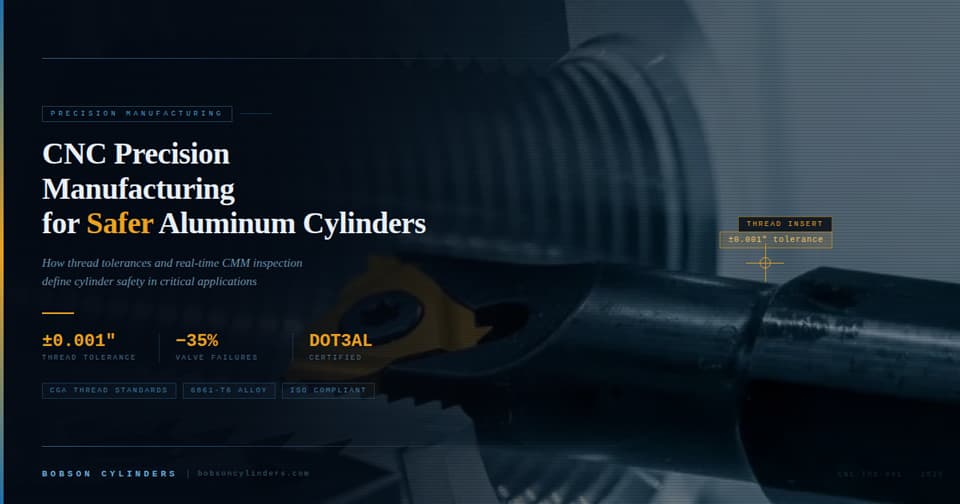
CNC machining has revolutionized how manufacturers produce high-pressure aluminum cylinders by introducing unprecedented levels of precision and repeatability. Traditional manufacturing methods often resulted in dimensional variations between cylinders, creating inconsistencies that could affect performance and safety. With CNC technology, manufacturers can achieve tolerances within 0.001 inches, ensuring every cylinder meets exact specifications.
The automated nature of CNC manufacturing eliminates human error from critical production steps. Computer-controlled machines execute the same operations identically across thousands of cylinders, producing components with uniform wall thickness, precise neck threading, and consistent base dimensions. This consistency is particularly crucial for DOT3AL certification, where every cylinder must meet strict federal safety standards for high-pressure gas containment.
Advanced CNC systems integrate real-time monitoring that detects anomalies during the manufacturing process. Sensors measure cutting forces, tool wear, and dimensional accuracy throughout production, automatically adjusting parameters or stopping operations when measurements fall outside acceptable ranges. This proactive quality control prevents defective cylinders from progressing through production stages, saving materials and ensuring only specification-compliant products reach customers.
Thread quality represents one of the most critical safety factors in aluminum cylinder manufacturing, and CNC machining delivers exceptional precision in this area. The neck threads where valves attach must be manufactured to exacting standards to prevent gas leaks, ensure proper valve seating, and withstand repeated installation and removal cycles. CNC thread milling produces cleaner, more accurate threads than traditional cutting methods.
Industry data shows that CNC-manufactured threads reduce valve connection failures by approximately 35% compared to conventionally cut threads. The superior surface finish achieved through CNC machining eliminates micro-tears and irregularities that can compromise seal integrity. For medical oxygen cylinders where even minor leaks pose patient safety risks, this improvement is invaluable.
Custom manufacturing capabilities enabled by CNC technology allow cylinder producers to accommodate various valve thread specifications for different applications. Whether producing soda cylinders with CGA 320 connections, medical oxygen cylinders with CGA 540 threads, or industrial gas cylinders with specialized fittings, CNC machines can be programmed to produce any thread configuration with identical precision, expanding product versatility for B2B customers.
Modern CNC manufacturing facilities integrate automated testing protocols directly into production workflows, dramatically improving quality assurance. Rather than relying solely on batch sampling, advanced systems perform 100% inspection of critical dimensions using laser measurement, coordinate measuring machines (CMM), and automated visual inspection systems.
This comprehensive testing approach has reduced cylinder defect rates from industry averages of 3-5% down to less than 1% in facilities using integrated CNC and quality control systems.** For B2B enterprises purchasing custom cylinders in volume, this translates to fewer rejected units, reduced downtime from cylinder failures, and lower total cost of ownership.
Traceability represents another significant quality advancement enabled by CNC manufacturing systems. Each cylinder can be tracked through every production stage with data recorded about machining parameters, inspection results, and heat treatment cycles. This documentation provides essential quality verification for DOT3AL certification and gives customers confidence in product consistency.
CNC precision machining optimizes material utilization by removing only the exact amount of aluminum necessary to achieve final cylinder specifications. Advanced CAM software calculates optimal tool paths that minimize material waste while maximizing production speed. In aluminum cylinder manufacturing, this can reduce raw material waste by 15-25% compared to conventional methods.
The ability to work with advanced aluminum alloys represents another manufacturing advantage of CNC technology. Newer high-strength aluminum alloys designed for improved pressure resistance and durability can be more challenging to machine than traditional materials. CNC systems handle these advanced alloys effectively through precise control of cutting speeds, feed rates, and tool selection, enabling manufacturers to leverage material innovations for enhanced cylinder performance.
Reduced waste and improved material efficiency contribute to more sustainable manufacturing practices while lowering production costs. For environmentally conscious B2B customers and applications in clean energy sectors like hydrogen storage, these sustainability benefits complement the performance advantages of precision-manufactured aluminum cylinders.
CNC manufacturing's inherent precision and consistency directly supports compliance with DOT3AL and other safety certifications required for high-pressure cylinders. Certification agencies require demonstrated manufacturing control and quality assurance processes, which CNC systems provide through documented, repeatable production methods.
Statistical process control (SPC) data generated by CNC manufacturing systems provides objective evidence of production consistency required for regulatory compliance. This documentation demonstrates that cylinders consistently meet dimensional specifications, pressure testing requirements, and material standards across production runs, streamlining certification processes and audits.
For safety-critical applications including medical oxygen delivery, firefighter breathing air systems, and industrial gas handling, the enhanced reliability of CNC-manufactured cylinders provides additional safety margins. The combination of tighter tolerances, superior thread quality, comprehensive testing, and documented quality control reduces the risk of cylinder failures that could endanger personnel or disrupt operations.
CNC precision manufacturing represents a fundamental advancement in aluminum cylinder production, delivering measurable improvements in quality, safety, and consistency. The technology enables manufacturers to produce DOT3AL certified cylinders that meet the exacting requirements of medical, industrial, and safety-critical applications while reducing defects and improving efficiency.
For B2B enterprises requiring custom high-pressure cylinders with guaranteed quality and performance, CNC manufacturing provides the precision and reliability that critical applications demand. Contact Bobson Cylinders to learn how our advanced CNC manufacturing capabilities and quality control processes can deliver the custom aluminum cylinders your application requires.
