
A Global Leader in
High-Pressure Cylinders
and Green Energy
High-Pressure Cylinders
and Green Energy
Thermal properties are critical when selecting aluminum high pressure cylinders because aluminum's thermal expansion coefficient is approximately twice that of steel, affecting dimensional stability during filling and temperature fluctuations. For DOT3AL certified cylinders used in medical oxygen, CO2, and hydrogen storage, understanding thermal expansion, heat dissipation, and warping resistance ensures safe operation across varying temperatures while maintaining pressure integrity and valve seal reliability.
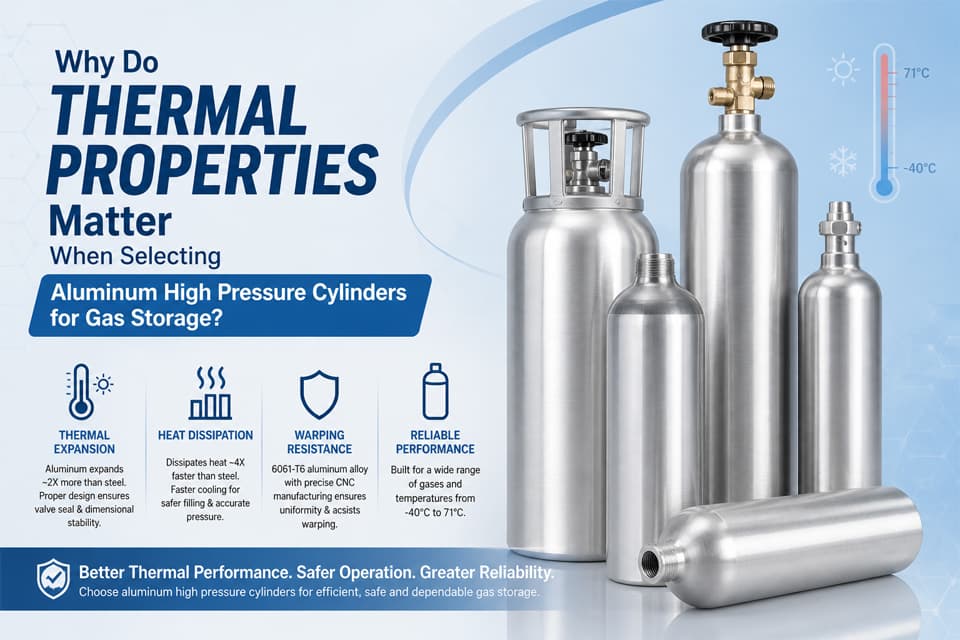
Aluminum expands at a rate of 23.1 micrometers per meter per degree Celsius, compared to steel's 11.7 micrometers, making thermal management essential for high pressure cylinder design. This significant difference impacts thread integrity, valve connections, and overall dimensional stability during the filling process when cylinders experience rapid temperature changes. When compressed gases enter a cylinder, the compression process generates heat, causing the aluminum body to expand temporarily before cooling to ambient temperature.
DOT3AL certified manufacturers like Bobson Cylinders account for thermal expansion through precise alloy selection and manufacturing tolerances. The 6061-T6 aluminum alloy commonly used in high pressure cylinders offers an optimal balance between strength, thermal stability, and workability. This alloy maintains structural integrity across operating temperatures from -40°F to 160°F (-40°C to 71°C), the typical range for medical oxygen cylinders, soda carbonation systems, and industrial gas applications.
Proper thread design compensates for thermal expansion to maintain valve seal integrity throughout temperature cycles. Custom manufacturing processes ensure that valve threads maintain proper engagement even as the cylinder body expands and contracts. This consideration is particularly important for applications involving frequent filling cycles, where repeated thermal stress could compromise poorly designed connections.
Aluminum's thermal conductivity of 167 W/m·K allows heat generated during rapid filling to dissipate approximately four times faster than steel cylinders. This superior heat dissipation capability reduces the risk of over-pressurization due to temperature-induced pressure spikes. During fast-fill operations common in medical facilities and industrial settings, aluminum cylinders reach thermal equilibrium more quickly, allowing for more accurate pressure readings and safer filling procedures.
The faster cooling rate of aluminum high pressure cylinders means less wait time between filling and deployment in medical oxygen and emergency response applications. Steel cylinders retain heat longer, requiring extended cooling periods to achieve accurate final pressure readings. Aluminum cylinders used in SCBA systems, portable medical oxygen units, and mobile industrial applications benefit from this rapid heat dissipation, improving operational efficiency for B2B enterprises managing large cylinder inventories.
Temperature stabilization affects final cylinder pressure, and aluminum's thermal properties provide more predictable pressure behavior. When a cylinder cools after filling, the internal pressure decreases according to Gay-Lussac's Law. Aluminum cylinders reach stable operating pressure faster, reducing the likelihood of under-filled cylinders that could impact customer satisfaction and operational planning in medical and industrial gas distribution networks.
Quality aluminum alloys with proper heat treatment resist warping under normal operating conditions, but understanding thermal limits prevents cylinder deformation. The T6 temper treatment used in DOT3AL certified aluminum cylinders creates a stable metallurgical structure that maintains dimensional integrity across standard temperature ranges. However, exposure to temperatures exceeding 350°F (177°C) can compromise the temper, reducing strength and potentially causing permanent deformation.
CNC precision manufacturing ensures uniform wall thickness, which is critical for preventing localized stress points that could warp under thermal cycling. Advanced manufacturing techniques employed by specialized manufacturers like Bobson Cylinders maintain thickness tolerances within 0.010 inches, ensuring even thermal expansion across the cylinder body. Inconsistent wall thickness creates differential expansion rates that can lead to warping, particularly in cylinders subjected to rapid temperature changes during filling operations.
Hydrogen storage applications place particular emphasis on thermal stability due to the extreme pressure requirements and potential for hydrogen embrittlement under thermal stress. DOT3AL cylinders designed for hydrogen service incorporate specific alloy compositions and manufacturing processes that account for both high-pressure requirements and thermal cycling effects. The interaction between hydrogen molecules and aluminum crystal structure under varying temperatures requires careful material selection to prevent degradation over the cylinder's service life.
Medical oxygen cylinders experience moderate temperature fluctuations, making aluminum's thermal properties ideal for healthcare environments. Hospital and home healthcare applications typically involve indoor storage with controlled ambient temperatures and relatively gentle filling procedures. Aluminum cylinders in these applications benefit from lightweight portability while the thermal expansion characteristics remain well within design parameters for DOT3AL certification standards.
CO2 cylinders for soda carbonation systems face unique thermal challenges due to the phase-change characteristics of carbon dioxide. CO2 transitions between gas and liquid states at relatively low pressures and temperatures, making thermal stability crucial for consistent beverage carbonation. Aluminum's heat dissipation properties help maintain stable CO2 pressure in commercial beverage systems, restaurant applications, and home soda makers where ambient temperature variations could otherwise affect carbonation levels.
Industrial gas cylinders for welding, manufacturing, and chemical processing must withstand more extreme thermal environments. These applications may involve outdoor storage with seasonal temperature swings, proximity to heat-generating equipment, or transportation in non-climate-controlled vehicles. Custom aluminum cylinders designed for these demanding applications incorporate enhanced alloy specifications and protective coatings that maintain thermal performance across wider temperature ranges.
DOT3AL certification requires hydrostatic testing that evaluates cylinder performance under pressure while accounting for thermal effects. Manufacturers must demonstrate that cylinders maintain structural integrity and return to original dimensions after pressurization, confirming that thermal expansion during the test cycle does not cause permanent deformation. This testing protocol ensures that aluminum high pressure cylinders will perform safely throughout their service life despite repeated thermal cycling.
Advanced quality control processes include thermal cycling tests that simulate real-world temperature variations during filling and storage. Leading manufacturers conduct accelerated lifecycle testing where cylinders undergo rapid heating and cooling cycles while pressurized, identifying potential failure modes before products reach customers. These rigorous testing protocols provide B2B enterprises with confidence that their aluminum cylinder investments will deliver reliable performance across diverse operating conditions.
Material certification and traceability ensure that each aluminum cylinder meets specified thermal performance standards from raw material through final production. Heat lot tracking for aluminum alloys confirms that the thermal expansion coefficients, conductivity values, and temper characteristics match design specifications. This documentation becomes particularly important for custom manufacturing projects serving medical, aerospace, and clean energy sectors where regulatory compliance and performance assurance are non-negotiable requirements.
Understanding thermal properties is essential for selecting the right aluminum high pressure cylinders for your specific gas storage needs. Whether your application involves medical oxygen delivery, industrial gas handling, beverage carbonation, or emerging hydrogen storage solutions, thermal performance directly impacts safety, reliability, and operational efficiency. Contact Bobson Cylinders today to discuss how our DOT3AL certified aluminum cylinders and custom manufacturing capabilities can meet your thermal performance requirements and application specifications.
