4500 PSI High-Pressure Cylinders Are Not a Spec Choice - They're a Design Commitment
2026.01.12
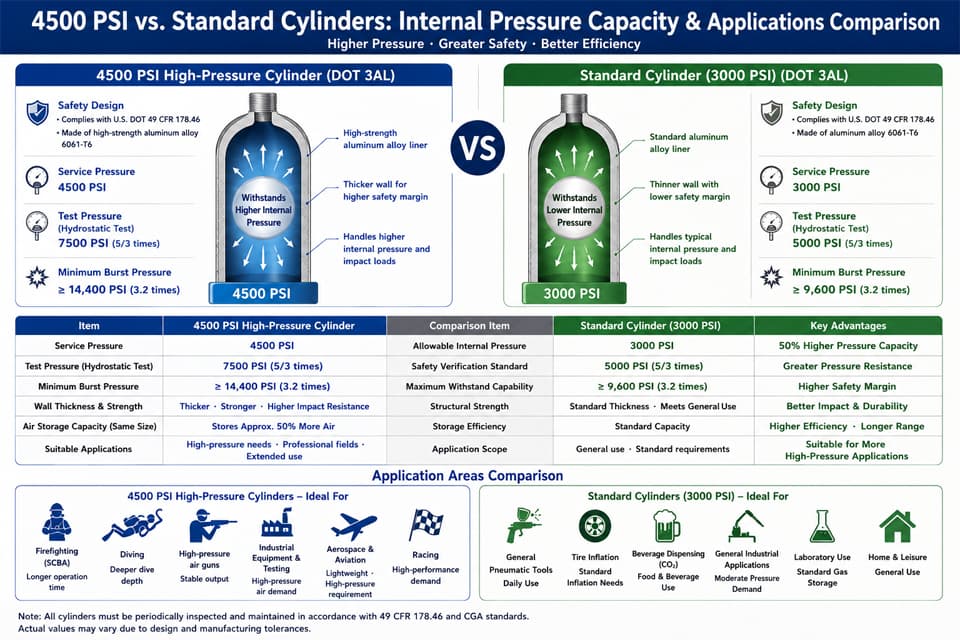
The 4500 PSI high-pressure cylinder (approximately 310 bar) is a critical choice for medical rescue, industrial high-pressure, and drone systems. The key to making the right choice lies in three conditions: material stability, cycle life, and regulatory certification. This article explains Bobson's design logic in choosing 6061-T6 aluminum alloy and which application scenarios truly require this level.
4500 PSI High-Pressure Cylinders: Three Core Purchasing Criteria
- Material: 6061-T6 aluminum alloy; excellent high-pressure ductility, rust-free, and long-term stability
- Certification: Compliant with DOT 3AL specifications, covering pressure resistance, burst, and cyclic testing
- Applications: Medical rescue, industrial high-pressure systems, drones, and high-performance mobile equipment
High-Pressure Cylinder Material Comparison: Why Choose 6061-T6 Aluminum Alloy?
In high-pressure applications, material selection directly determines the safety factor and service life of the cylinder. Bobson chooses 6061-T6 aluminum alloy not because of industry convention, but because it provides the most controllable balance across the following four key indicators:
Bobson's 4500 PSI Manufacturing Standards: Three Quantifiable Stages
Bobson sets quantifiable standards at every manufacturing stage of 4500 PSI cylinders to ensure quality is built in from the design phase, rather than relying on end-of-line inspections:
- Structural Design Phase: Incorporates long-term fatigue analysis and actual use scenario simulations, rather than merely meeting static pressure resistance specifications
- Manufacturing Process: Key steps have quantifiable records to support quality traceability
- Regulatory Testing Phase: The entire series strictly complies with DOT 3AL specifications, covering standardized pressure resistance, burst, and cyclic testing
Which Application Scenarios Require 4500 PSI?
- Medical and Emergency Rescue: Extending gas supply time within a limited volume while maintaining a high degree of safety redundancy
- Industrial Gases and High-Pressure Applications: Long-term, high-frequency cyclic use, prioritizing system stability
- High-Performance Mobile Systems (Paintball Guns, Airguns, Drones): Weight, efficiency, and structural safety must be satisfied simultaneously
FAQ
- What is a 4500 PSI high-pressure cylinder?
4500 PSI refers to the rated pressure that the cylinder can withstand (approximately 310 bar). Compared to standard cylinders, it can store more gas and is commonly used in high-end medical, rescue, and professional high-pressure power equipment.
- What regulations do Bobson's 4500 PSI cylinders comply with?
Bobson's entire product line strictly complies with DOT 3AL specifications, encompassing standardized pressure resistance testing, burst testing, and cyclic testing.
- Why is 6061 aluminum alloy more suitable for high pressure than traditional steel cylinders?
6061-T6 aluminum alloy possesses excellent ductility under high internal pressure, will not experience brittle failure, and its weight is about half that of a steel cylinder of the same specification, reducing the overall equipment load.
- What is the service life and maintenance requirement of a 4500 PSI cylinder?
Under conditions compliant with DOT 3AL specifications, aluminum alloy cylinders must undergo a hydrostatic test every five years; if they pass, they can continue to be used. With normal maintenance, the interior of the aluminum alloy material does not rust, resulting in a long service life.
- How to choose the right high-pressure cylinder for my industry?
It is recommended to confirm three conditions: operating pressure range (whether a 310 bar level is needed), operating environment (temperature difference, salt spray, vibration), and regulatory certification requirements (DOT 3AL, ISO). You can refer to Bobson's 4500 PSI product section or contact the technical team for a customized assessment.