
A Global Leader in
High-Pressure Cylinders
and Green Energy
High-Pressure Cylinders
and Green Energy
Hydrostatic testing for gas cylinders is a non-destructive safety validation method that pressurizes cylinders with water to test pressures exceeding normal service levels to verify structural integrity and identify potential weaknesses before field deployment.
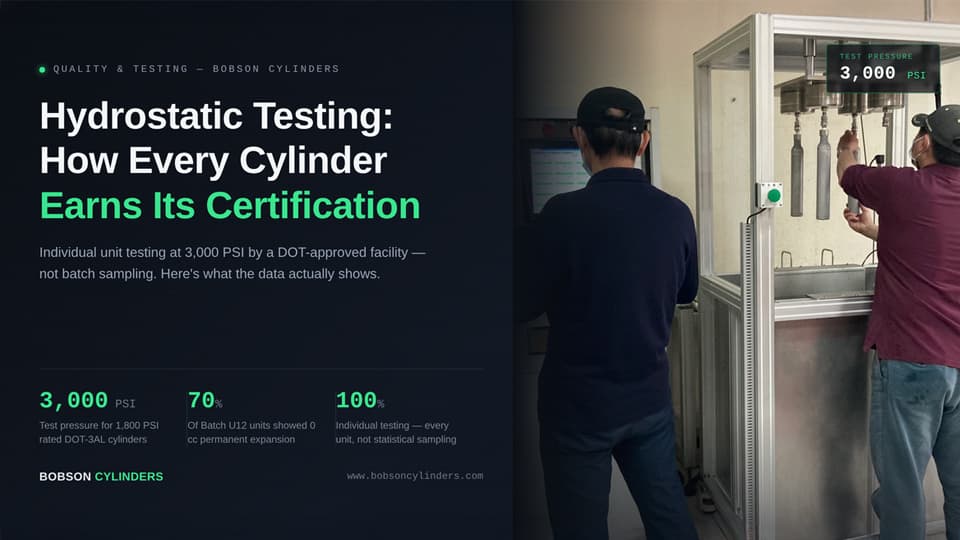
DOT-3AL aluminum cylinders must undergo hydrostatic testing at 3,000 PSI test pressure for cylinders rated at 1,800 PSI service pressure. This 1.67x safety factor ensures cylinders can safely handle operational stresses with adequate margin. The Department of Transportation mandates this testing for initial certification and periodic requalification every 5 years.
The test medium must be water, never compressed gas, because water's incompressibility provides precise pressure control while eliminating explosion risk. Water pressure increases gradually to the required 3,000 PSI test level, held for 30 seconds minimum, then released while measuring any permanent volume change.
Bobson Cylinders manufactured from AA6061-T6 aluminum alloy with batch U12 tensile strength of 362-367 MPa (37-38% above DOT minimum of 265 MPa) consistently demonstrate exceptional hydrostatic performance. This superior material strength translates directly to better test results and longer service life.
Permanent expansion measurement is the critical safety metric during hydrostatic testing. When test pressure is applied and released, cylinders may retain some volume increase due to material yielding. DOT regulations set the maximum allowable permanent expansion at 10% of total elastic expansion.
Batch U12 Bobson cylinders achieved remarkable results: 70% showed 0 cc permanent expansion, with maximum observed permanent expansion of only 4% - well below the DOT ceiling of 10%. This superior performance indicates minimal material stress and extended fatigue life.
The permanent expansion calculation uses the formula: (Total Expansion - Elastic Recovery) ÷ Total Expansion × 100%. Cylinders exceeding 10% permanent expansion fail the test and cannot enter service. This stringent requirement ensures only structurally sound cylinders reach end users.
Testing equipment measures expansion using water jacket methods or direct strain measurement. Water jacket testing places the cylinder inside a calibrated water-filled chamber, measuring displaced water volume as the cylinder expands under pressure.
Individual unit testing provides superior quality assurance compared to batch sampling methods. Every Bobson cylinder undergoes individual hydrostatic testing by Advanced Cylinder Certification Inc., a DOT-approved testing facility, ensuring 100% verification rather than statistical sampling.
This comprehensive approach eliminates the risk of defective units passing through batch sampling gaps. Manufacturing variations, material inconsistencies, or processing defects that might affect individual cylinders are detected before shipment.
Bobson's no-stock policy means hydrostatic test dates equal ship dates, so buyers receive cylinders with full remaining service life. Each shipment includes individual hydrostatic records by serial number, providing complete traceability and documentation for regulatory compliance.
The 1-month lead time from order to delivery includes fresh testing, ensuring customers never receive cylinders with expired test dates or reduced remaining service periods.
Professional hydrostatic testing follows strict DOT protocols. Cylinders undergo visual inspection for surface defects, corrosion, or mechanical damage before testing. Any cylinder showing suspicious conditions receives additional scrutiny or rejection.
Testing chambers must maintain precise pressure control with calibrated instrumentation traceable to NIST standards. Pressure gauges require annual calibration with accuracy within ±0.5% of full scale reading.
Temperature control during testing is critical because thermal expansion affects results. Testing typically occurs at ambient temperature between 60-100°F, with temperature variations documented.
Bobson cylinders benefit from superior heat treatment certification with continuous actual temperature curves attached. Stage 1 occurs at 535°C ±5°C for 2 hours, followed by critical quenching within 3 seconds of furnace exit to prevent non-uniform decomposition that cannot be corrected.
Contact: [email protected] | www.bobsoncylinders.com
