
A Global Leader in
High-Pressure Cylinders
and Green Energy
High-Pressure Cylinders
and Green Energy
The most significant aluminum alloy innovation in high-pressure cylinder manufacturing is the proven application of AA6061-T6, which delivers tensile strength 37-38% above DOT minimum requirements (362-367 MPa versus the 265 MPa baseline). This performance comes from controlled T6 heat treatment that creates uniform Mg2Si precipitates through two-stage processing: solution heat treatment at 535°C for 2 hours, followed by a critical 3-second quench window, then artificial aging at 170°C for 6+ hours. These precisely controlled metallurgical transformations separate high-performance cylinders from standard-grade containers.
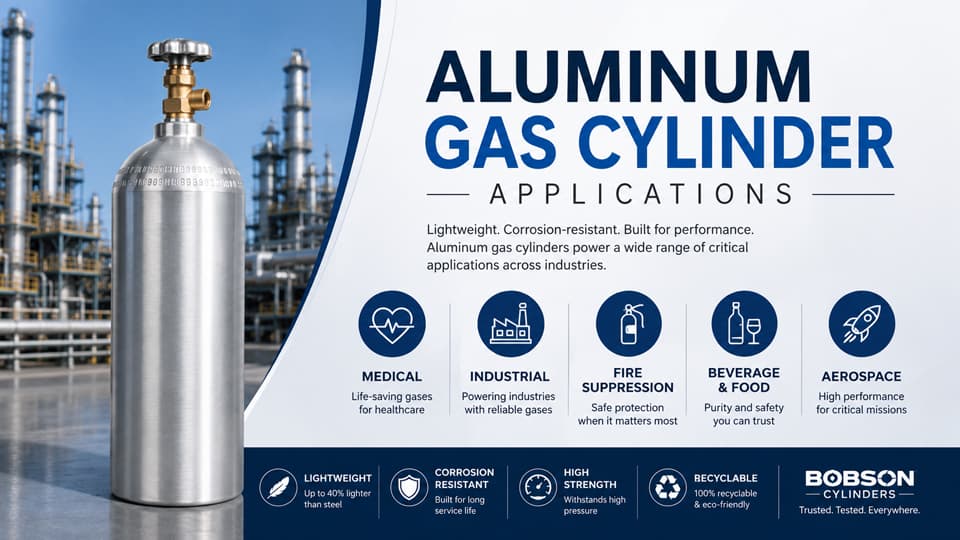
While research teams continue developing experimental alloys, AA6061-T6 aluminum represents the highest-performance grade currently certified for high-pressure cylinder manufacturing under DOT3AL and TC-3ALM standards. The T6 designation refers to a specific temper condition: full solution heat treatment combined with artificial aging. This process transforms the alloy's microstructure by forming uniform Mg2Si precipitates that maximize strength without compromising ductility.
Bobson Cylinders' Batch U12 testing demonstrates what proper AA6061-T6 processing achieves. Actual tensile strength measured 36.94-37.38 kgf/mm² (362-367 MPa), exceeding DOT minimum specifications by 37-38%. Yield strength reached 33.85-35.61 kgf/mm², which is 38-45% above the DOT minimum of 241 MPa. Elongation performance of 15.16-15.94% surpassed the 14% DOT requirement, confirming the alloy maintains necessary ductility for pressure cycling.
The innovation is not in the alloy composition itself but in manufacturing precision. AA6061-T6's magnesium and silicon content creates the Mg2Si precipitates that provide strength, but only when heat treatment follows exact parameters. Temperature deviation of just 5°C during solution treatment or exceeding the 3-second quench window causes non-uniform precipitate distribution that subsequent aging cannot correct. The result is cylinders that appear identical but deliver reduced performance invisible to visual inspection.
The most overlooked innovation in aluminum cylinder manufacturing is not a new alloy formula but process control precision during heat treatment. After holding AA6061 aluminum at 535°C ±5°C for 2 hours, the cylinder must enter quench water within 3 seconds of furnace exit. This narrow window determines whether the supersaturated solid solution transforms uniformly or decomposes unevenly.
Exceeding 3 seconds allows premature precipitation during cooling, creating non-uniform Mg2Si distribution throughout the cylinder wall. Subsequent artificial aging cannot compensate for this early precipitation because the silicon and magnesium have already bonded in uncontrolled patterns. The finished cylinder may pass dimensional inspection but will underperform in long-term pressure cycling.
Bobson enforces this 3-second requirement through physical production line configuration, not operator discipline. Furnace exit stations position cylinders 2.8 meters from quench tanks, with gravity-assisted transfer mechanisms that guarantee water immersion within the critical window. Every batch produces a formal heat treatment certificate signed by the facility manager, with attached continuous temperature curve recording actual temperatures and quench delay, not target setpoints.
This documentation approach reflects a broader innovation in cylinder manufacturing: shifting from design certification to individual unit verification. DOT3AL certifies a cylinder design, not individual units. The alloy innovation that matters to procurement teams is not tensile strength potential but verified tensile strength with documented test results traceable to specific production batches.
Traditional aluminum cylinder quality control relies on batch sampling: testing representative units from production runs and certifying the entire batch based on sample performance. This statistical approach works for consistent processes but introduces risk when heat treatment precision determines performance. Bobson implements a four-stage verification chain that treats every cylinder as individually certified:
This individual verification approach represents the practical innovation in aluminum cylinder manufacturing: documented proof that each specific cylinder achieved the performance AA6061-T6 is capable of delivering.
AA6061-T6 aluminum cylinders deliver approximately 40% weight reduction compared to equivalent-specification steel cylinders. For procurement teams managing high-volume logistics, this translates directly to transportation cost reduction and improved handling safety for warehouse staff.
A medical oxygen cylinder that weighs 2.4 kg versus a 4.0 kg steel equivalent reduces shipping costs across every distribution stage. More importantly, the weight difference affects worker safety during loading, unloading, and positioning operations that occur thousands of times across a cylinder's service life.
The flattening test results from Batch U12 demonstrate that this weight reduction does not compromise structural integrity. Cylinders withstood 9x wall thickness compression with no cracks, confirming the alloy maintains toughness despite reduced mass. This performance comes from AA6061-T6's strength-to-weight ratio, which exceeds steel when properly heat treated.
Every Bobson shipment includes a standard documentation package that enables procurement teams to satisfy regulatory, insurance, and internal safety review requirements:
This documentation approach reflects Bobson's position as a direct manufacturer, not a trader. Production control enables documentation generation at each verification stage because Bobson controls material selection, heat treatment execution, mechanical testing, and coordinates third-party hydrostatic testing before shipment.
The alloy innovation that matters most to B2B procurement is not theoretical performance but documented, verified, traceable results for every cylinder in every shipment. Monthly capacity of 20,000+ units with 1-month lead time demonstrates this documentation approach scales to high-volume orders without compromising individual unit verification.
Contact Bobson Cylinders to discuss how AA6061-T6 aluminum cylinders with complete documentation chains address your specific procurement requirements for medical oxygen, industrial gas, soda, or custom pressure vessel applications.
