
A Global Leader in
High-Pressure Cylinders
and Green Energy
High-Pressure Cylinders
and Green Energy
It is early morning, and Mr. Chen is getting ready for his daily walk. He fastens a protective belt around his waist, picks up his keys and heads toward the front door.
As he crosses the doorway, his shoe catches the edge of a mat. His body tilts sideways before his hand can reach the wall. If the belt can recognize the movement and deploy an airbag before impact, his hip may gain an additional layer of cushioning.
This is an illustrative scenario, not a documented accident or a guarantee of product performance.
From senior-care airbag belts to motorcycle, equestrian and industrial airbag vests, these devices face a shared challenge: triggering and deploying protection within a brief accident sequence. As sensing technology and AI become part of protective equipment, OEM gas cylinder manufacturing must respond to specific size, weight and integration requirements.
This article examines existing international products and the questions equipment brands should address when developing their gas-storage components.
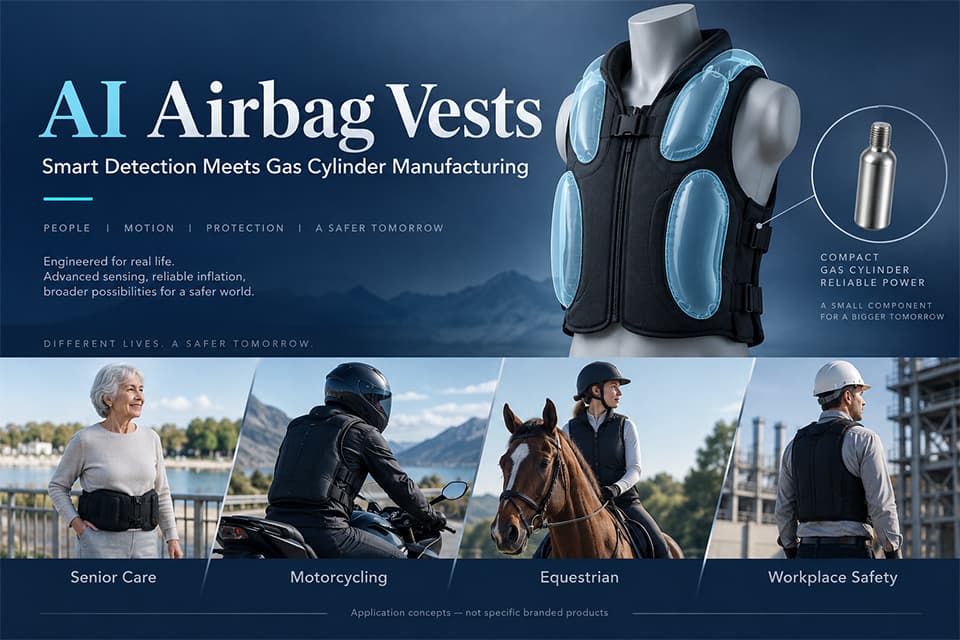
Application concepts, not specific branded products. The senior-care example is a belt; not every product uses AI.
An airbag vest contains an inflatable protective structure. A conventional protective vest may instead rely on armor or cushioning materials. A product described as a protective vest should not automatically be assumed to include an airbag or AI.
The related senior-care device discussed here is an airbag belt rather than a vest. Intended use, protected body regions and activation conditions differ between products, so these devices should not be treated as interchangeable.
Yes. AI or predictive algorithms can help identify hazardous movement, while an inflation mechanism deploys the airbag. Sensors, control electronics and protective structures must work together.
For a system combining electronic detection with stored-gas inflation, the process can be summarized as:
Motion sensing → risk assessment → activation signal → gas release → airbag deployment.
In&motion describes a system that analyzes acceleration and rotational movement 1,000 times per second using predictive algorithms. This is an analysis frequency, not the time required for the entire airbag to inflate. Source: In&motion technology overview
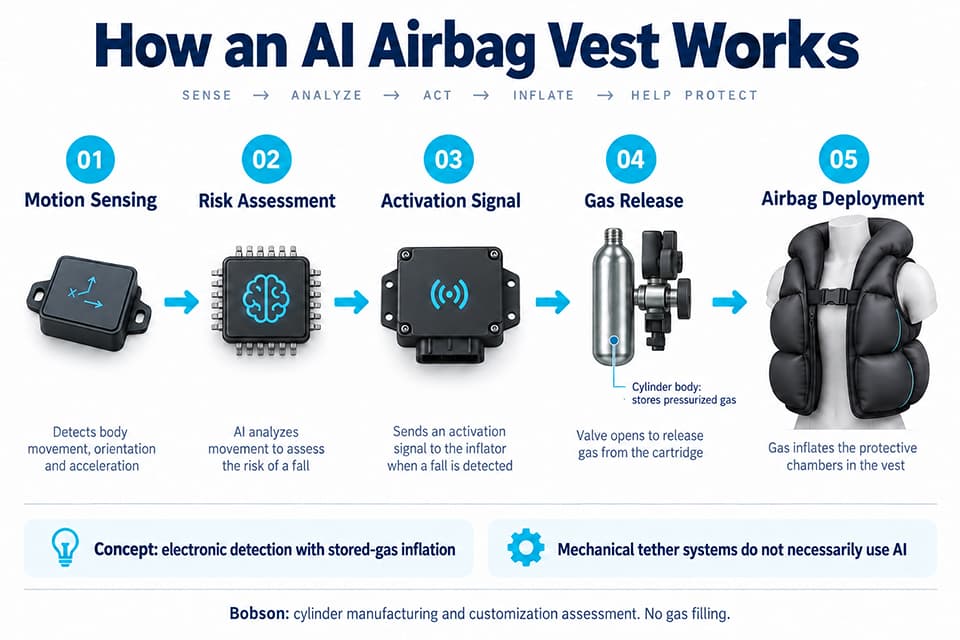
Conceptual sequence for an electronic, stored-gas system; not a universal construction diagram for every airbag product.
AI can help distinguish normal activity from an event that may require protection. The cylinder has a separate function: it contains pressurized gas. It does not detect a fall, and AI does not automatically improve its pressure resistance or leak performance.
Electronic detection does not necessarily mean AI. Some products use electronic algorithms, while others rely on mechanical activation. Descriptions should follow the documentation for the specific model.
Commercial products cover all four application areas, but detection methods, inflation hardware and intended protection differ. These examples do not imply that Bobson supplies the brands or that its cylinders are approved replacements for their components.
Senior care: Hip'Guard airbag belt
Hip'Guard, which is built on Helite's airbag technology, uses a motion-analysis algorithm to detect falls and deploy cushioning around the hips. Following deployment, its gas cartridge must be replaced according to the manufacturer's procedure. Source: Hip'Guard technology overview
This is relevant to senior-care and assistive-product development. Use by older adults does not by itself establish medical-device status in a particular country. Classification and permitted claims require separate confirmation.
Motorcycling: KLIM Ai-1 Airbag Vest
KLIM describes the Ai-1 and its In&motion platform as AI-driven protection with continuing algorithm updates. Specifications also identify a replaceable compressed inert-gas inflator. Source: KLIM Ai-1 product page
Software and inflation hardware must work together. Cylinder capacity alone does not establish compatibility with a motorcycle airbag vest.
Equestrian activities: Helite Zip'In 2
Helite's Zip'In 2 uses mechanical tether activation and a CO₂ cartridge. It is an established airbag vest example, but it should not be presented as an AI product. Source: Helite equestrian airbag information
Mechanical systems also need carefully specified gas containers. Cylinder manufacturing opportunities therefore extend beyond electronically controlled equipment.
Workplace safety: SAFEWARE C3
South Korea's SAFEWARE reported cumulative supply of more than 25,000 C3 industrial airbag units in September 2025 and described AI fall-detection technology. This is a company-reported milestone, not a measure of the entire market. Source: SAFEWARE announcement
A separate official application report describes CO₂ cartridges paired with electronic inflators, demonstrating a gas-storage and release requirement in industrial wearable protection. Source: SAFEWARE application report
| Application | Product example | Published detection approach | Relevance to cylinder development |
|---|---|---|---|
| Senior care | Hip'Guard airbag belt | Electronic fall-detection algorithm | Replaceable cartridge; waist-mounted packaging |
| Motorcycling | KLIM Ai-1 Airbag Vest | In&motion platform, described as AI-driven | Compressed inert-gas inflator integrated with the system |
| Equestrian activities | Helite Zip'In 2 | Mechanical tether activation | CO₂ cartridge with specified capacity and interface |
| Workplace safety | SAFEWARE C3 | Manufacturer describes AI fall detection | Published application uses a CO₂ cartridge and electronic inflator |
A cylinder is a pressure vessel; a cartridge is typically a device-specific gas unit; an inflator is the assembly that delivers gas to the airbag. These terms should not be treated as interchangeable.
Manufacturers may use "cartridge," "canister" and "inflator" differently. Drawings and supply specifications should define what each component includes.
Inflators do not all use the same internal architecture. Connecting an arbitrary high-pressure cylinder to a trigger does not create a validated protective system.
For a cylinder manufacturer, the first step is to define the supply scope and interfaces with other suppliers. Bobson's role here is cylinder manufacturing and customization assessment, without gas-filling services.
| Component | Meaning used here | Question for procurement |
|---|---|---|
| Cylinder or cylinder body | Pressure vessel that contains gas | Is the scope limited to the vessel itself? |
| Gas cartridge | Device-specific gas unit, potentially including a closure or interface | Does supply include filling, sealing or valves? |
| Inflator | Assembly that produces or releases the gas flow needed for inflation | Which actuator, gas source and flow components are included? |
Start with the complete device requirements, then translate them into a cylinder specification that can be manufactured and verified. Price and minimum size are not sufficient selection criteria.
Equipment developers should prepare six groups of information:
Aluminum may be a candidate for lightweight designs, but suitability for a miniature cartridge depends on pressure requirements, geometry, interfaces and manufacturing processes. An existing cylinder should not be assumed suitable simply because both products store gas.
Bobson can assess cylinder requirements through its high-pressure aluminum cylinder manufacturing and OEM/ODM capabilities. Acceptance of a particular application requires review of the actual design and specifications.
Bobson's website identifies 6061-T6 aluminum, individual hydrostatic testing and customization among its capabilities. These provide a starting point for supplier discussions, rather than evidence that a particular airbag vest has been validated. Explore Bobson's manufacturing capabilities
Developers can begin with a cylinder drawing, intended gas, operating conditions, dimensional limits and estimated quantities. Bobson's OEM/ODM FAQ provides additional service information.
Clearly assigning responsibility for the vessel, valves, activation hardware, filling and complete-system validation helps align OEM gas cylinder manufacturing with equipment development.
